
Are your friend’s auto insurance rates cheaper than yours? No, it’s not because they’re best buds with their broker – it’s because there are multiple factors that are considered when car insurance rates are calculated. It all really comes down to risk – and the lower your risk profile the more likely you are to score cheap car insurance premiums. Let’s unpack some of the factors that may be driving your premiums higher and how we can drive them back down.
Behind The Scenes
To gain a better perspective, when insurance companies are determining what to charge for auto insurance, they are essentially trying to calculate the cost of claims they will pay in the future. In trying to perfect this science, over the years, insurance companies have found a variety of factors they deem consistent indicators of future claim activities.
1. Driver Age
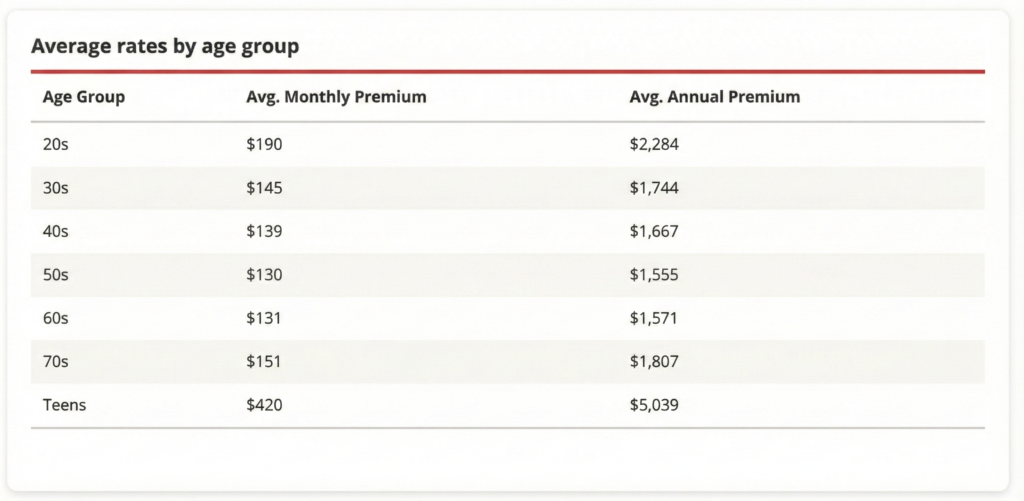
This is probably one of the biggest factors influencing how much you’re going to pay for your car insurance in Oklahoma. The first thing an auto insurance company is going to do is look for your age. Younger drivers (like your 16 year-old fresh out of the DMV) are seen as less experienced and more likely to engage in risky behaviours that can cause accidents. For example, monthly premiums for teens can be as high as $420, while this drops sharply to $190 in your 20s and right down to as little as $130 in your 50s. it then begins to increase again for senior drivers.
2. Claims History
Are your past mistakes on the road driving your premiums up? If you’ve claimed for an accident in the past, it likely is the reason your premium is higher. Insurance companies use your driving and claims history to assess your risk. If there’s a history of speeding tickets, DUI’s or other traffic violations, you can expect to be hit with higher premiums. Frequent claims are also seen as a red flag – even if they’re small claims like fixing dents or scratches.
Impact of Violations on Insurance Premiums
| Violation Type | Avg. Annual Premium | Cost Increase (vs. Clean Record) |
| None (Clean Record) | $1,759 | — |
| Texting while driving | $2,140 | +$381 |
| Speeding in school zone | $2,157 | +$398 |
| Speeding | $2,188 | +$429 |
| Accident | $2,429 | +$670 |
| Reckless driving | $3,187 | +$1,428 |
| Racing | $3,291 | +$1,532 |
| DUI | $3,441 | +$1,682 |
Impact of Insurance Claims on Annual Premiums
3. Credit Score
Your credit score has major sway when it comes to influencing your car insurance premium. Studies have found that drivers who have poor credit ratings tend to file more insurance claims than those with good credit profiles. Those claims also tend to be more expensive than their counterparts. Because of this, drivers with a bad credit score tend to pay around $130 more for their insurance per month.
| Credit Tier | Avg. Monthly Premium | Avg. Annual Premium | Annual Cost Increase (vs. Excellent) |
| Excellent | $125 | $1,506 | — |
| Very Good | $136 | $1,627 | +$121 |
| Good | $147 | $1,760 | +$254 |
| Average | $159 | $1,913 | +$407 |
| Fair | $173 | $2,071 | +$565 |
| Poor | $262 | $3,147 | +$1,641 |
4. Location
Location is another major factor that influences car insurance premiums. Rates vary significantly by state and zip code, with Oklahoma being on the higher side because of our unpredictable weather and winter driving conditions. Locations that see heavy traffic, extreme weather, higher crime rates and even “riskier” terrain will result in higher premiums. As a rule of thumb densely populated areas like cities and suburbs tend to be charged higher premiums whereas more rural areas enjoy lower premiums due to less claims and accidents.
| State | Avg. Monthly Premium | Avg. 6-Month Premium | Est. Annual Premium |
| Florida | $253 | $1,519 | $3,038 |
| Louisiana | $233 | $1,397 | $2,794 |
| Kentucky | $230 | $1,379 | $2,758 |
| Rhode Island | $199 | $1,195 | $2,390 |
| Delaware | $193 | $1,160 | $2,320 |
| Michigan | $193 | $1,156 | $2,312 |
| Nevada | $191 | $1,147 | $2,294 |
| Washington, D.C. | $184 | $1,104 | $2,208 |
| Colorado | $184 | $1,102 | $2,204 |
| New York | $183 | $1,099 | $2,198 |
| South Carolina | $179 | $1,074 | $2,148 |
| Maryland | $177 | $1,064 | $2,128 |
| Texas | $176 | $1,057 | $2,114 |
| Missouri | $175 | $1,050 | $2,100 |
| Oklahoma | $175 | $1,048 | $2,096 |
| Arkansas | $172 | $1,033 | $2,066 |
| Georgia | $170 | $1,020 | $2,040 |
| New Jersey | $169 | $1,015 | $2,030 |
| Montana | $169 | $1,012 | $2,024 |
| Alaska | $164 | $985 | $1,970 |
| California | $162 | $971 | $1,942 |
| Connecticut | $161 | $965 | $1,930 |
| Kansas | $160 | $960 | $1,920 |
| Pennsylvania | $158 | $947 | $1,894 |
| Arizona | $156 | $938 | $1,876 |
| Washington | $155 | $929 | $1,858 |
| New Mexico | $151 | $907 | $1,814 |
| Mississippi | $150 | $901 | $1,802 |
| Alabama | $149 | $896 | $1,792 |
| Nebraska | $146 | $877 | $1,754 |
| West Virginia | $146 | $874 | $1,748 |
| Utah | $145 | $870 | $1,740 |
| North Dakota | $143 | $855 | $1,710 |
| Minnesota | $142 | $852 | $1,704 |
| Tennessee | $139 | $834 | $1,668 |
| South Dakota | $139 | $832 | $1,664 |
| Illinois | $135 | $812 | $1,624 |
| Oregon | $134 | $806 | $1,612 |
| Virginia | $133 | $797 | $1,594 |
| Wyoming | $132 | $795 | $1,590 |
| Massachusetts | $119 | $716 | $1,432 |
| New Hampshire | $117 | $705 | $1,410 |
| Hawaii | $117 | $699 | $1,398 |
| Wisconsin | $116 | $694 | $1,388 |
| Iowa | $115 | $689 | $1,378 |
| Indiana | $111 | $669 | $1,338 |
| Ohio | $111 | $667 | $1,334 |
| Maine | $108 | $649 | $1,298 |
| North Carolina | $103 | $618 | $1,236 |
| Idaho | $102 | $612 | $1,224 |
| Vermont | $98 | $587 | $1,174 |
5. Gender
Men, especially teens, tend to pay up to $700+ more per year than females. This is because they are viewed as more likely to take risks while driving (speeding, overtaking, drinking and driving) than their female counterparts.
6. Coverage Level
Naturally, the higher your level of coverage and deductibles is, the more you are going to pay for your car insurance. For example, if you take out liability cover only, you’ll pay significantly less than you will taking out comprehensive coverage with a $5oo deductible.
7. Your Car
The car you drive plays a significant role in determining your car insurance premium. You might think older cars are cheaper to insure because they hold less value but having an old car can actually drive your premium up due to risk of breakdowns or mechanical failures. In the same breath luxury sports cars and SUVs generally attract a higher price tag because their replacement value is higher.
Insurance companies also consider things like how often your particular make and model is reported as stolen, its safety features and how much it costs to repair (e.g. are parts locally available or do they need to be shipped in specially?). This is why it’s very important to do your homework before buying a new car to ensure you’re buying a car that’s safe, low-risk and easy to repair if you want to keep your insurance premiums down. A great resource for gathering theft data on automobiles is the National Insurance Crime Bureau. At www.nicb.org, you can find the highest ranked stolen vehicles by state.
8. Mileage
The numbers of miles you put on your car every year can also influence your car insurance premiums. The more time you spend on the road, the more you’re exposing yourself to risk, so naturally someone who just does the school run every day is going to pay less than a sales rep who’s driving all over the state/country every month.
Impact of Annual Mileage on Car Insurance Rates
| Annual Mileage | Avg. Monthly Premium | Avg. 6-Month Premium | Est. Annual Premium | Cost Increase (vs. <7.5k miles) |
| 0 – 7,500 | $142 | $855 | $1,710 | — |
| 7,501 – 10,000 | $147 | $880 | $1,760 | +$50 |
| 10,001 – 15,000 | $150 | $898 | $1,796 | +$86 |
| 15,001+ | $152 | $913 | $1,826 | +$116 |
These are just a couple of factors many may not be aware of. Do note, not all insurance companies place the same weight on these factors. In fact, not all companies use the same factors when calculating their rates. This is one of the primary benefits of using an independent agent like Zoellner Insurance for your car insurance needs. Independent agents represent several different insurance companies and therefore have the benefit of comparing rates for you to find the best rate for the best coverage.